

7 Documents Investors Check Before Funding Your Startup in India | Due Diligence Checklist
What documents do investors check before funding a startup? This lesson covers the records investors review during due diligence before saying yes.
A practical, self-paced course that helps Indian founders understand the legal, tax, governance, people and fundraising decisions that shape a compliant, investor-ready startup.
It is a free, structured video course for Indian startup founders who want to understand company compliance before a filing, contract, hire, fundraise or investor diligence process creates avoidable risk. Lessons follow the published course sequence and explain the founder decision behind the rule—not only the legal terminology.
The curriculum is arranged by the lesson number published in each video. New BSA lessons continue to appear automatically without manual page updates.
Start with the lowest available lesson number and work forward. Each lesson opens on the official BSA YouTube channel.
34 lessons available
Visit the BSA YouTube channel for the latest videos.
What documents do investors check before funding a startup? This lesson covers the records investors review during due diligence before saying yes.

Your GST is not just a tax number. For B2B startups, GST compliance can directly impact client onboarding, invoicing, payments and vendor approval.

Paying a freelancer does not always mean your startup legally owns the work. Learn the IP assignment checks founders should make.

Friends and family funding feels easy in the early days, but undocumented money can create legal, tax, equity and relationship problems later.

Your first hires need clear employment terms, confidentiality, IP ownership and exit controls before they access the business.

Before appointing a marketing agency, check scope, brand ownership, customer data, approvals, payment terms and exit rights.

When a branch, warehouse or office closes, founders should update the GST registration and retain evidence of the change.

Funding, foreign investment, ESOPs and share transfers often require a valuation record that matches the transaction and the law.

Learn the fundraising terms investors use so your term sheet, valuation and cap-table conversations are clear.

Understand the Startup India Section 80-IAC tax-holiday route, eligibility questions and the records founders should prepare.

Learn how ESOP grants, vesting, exercise, dilution and tax questions affect founders and employees.

A practical guide to finding relevant Indian VC investors by stage, sector, cheque size and founder fit.

Avoid common documentation and eligibility mistakes that can weaken a Startup India tax-exemption application.
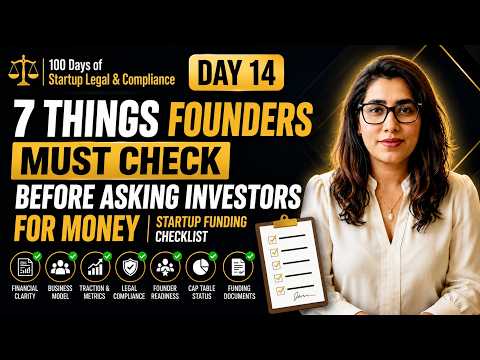
Before investor outreach, check your traction, cap table, documents, use of funds, valuation story, compliance and data room.

Investors assess more than the idea. Learn the founder, market, numbers, documentation and execution mistakes that create avoidable rejection.

A strong pitch deck makes the problem, market, traction, model, team, ask and risks easy for investors to evaluate.

Understand pre-money, post-money, dilution and the evidence you need to defend a startup valuation.

Funding changes ownership. Learn how to model dilution, option pools and investor shares before agreeing to a round.

Prepare the information, documents and founder decisions needed for a smoother private limited company registration.
The course connects legal requirements to everyday founder decisions so you can identify risks early, ask better questions and prepare cleaner records.
Understand recurring company obligations, annual filings, dematerialisation and record-keeping discipline.
Recognise the clauses, ownership terms and exit risks that matter before signing.
Spot common tax mismatches, registration triggers and documentation gaps before notices arise.
Prepare practical HR policies, POSH systems and employee exit documentation.
Understand how brands, code, inventions, content and employee-created assets should be protected.
Prepare for investor review across FEMA, finance, contracts, cap tables and compliance evidence.
Follow the numbered sequence so each topic builds on the founder decisions covered earlier.
After each lesson, compare the concept with your company documents, filings, contracts and internal controls.
Use the course to identify the issue, then seek professional guidance before acting on company-specific facts.
Yes. The available lessons can be watched free on the official BSA YouTube channel, with no course sign-up or paywall.
Yes. The page arranges the available videos by their published lesson number so founders can follow the learning path from the earliest available lesson forward.
The existing BSA video feed updates the page automatically when new lessons are published. The course layout then places each lesson according to its number.
It is designed for Indian startup founders, co-founders, SME owners and finance, legal, HR or operations leads who need practical compliance awareness.
No certificate is currently claimed on this page. It is a free educational learning path intended to improve founder understanding and decision-making.
No. The lessons provide general education. Professional advice should consider your company structure, transactions, documents, dates and applicable law.
Send the specific question to Bhavya Sharma & Associates on WhatsApp for a practical next-step discussion.